

Buying a Duplex as a First Home: The Real Math (2026)
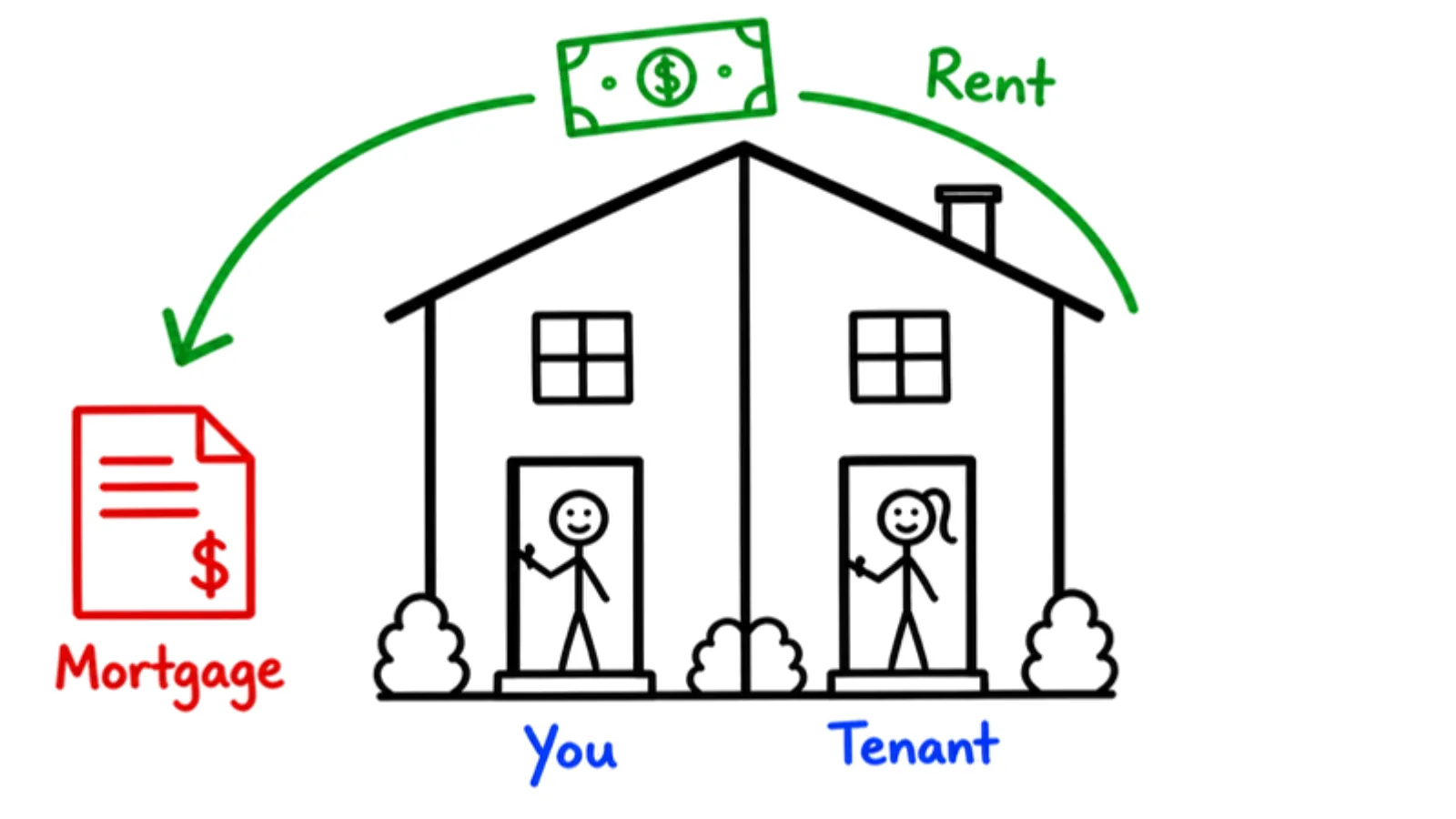
Buying a duplex as a first home is the one move I’d tell almost any first-time buyer to at least price out. You live on one side, a tenant lives on the other, and their rent pays a chunk of your mortgage.
It only works if you know how the loan treats it and you run the numbers on real rent. Most articles skip both.
Short answer: Yes, you can buy a duplex as your first home. If you live in one unit, lenders treat it as your primary residence, so FHA (3.5% down), conventional (5% down) and VA (no down payment for eligible veterans) loans all work on two units. Lenders typically count 75% of the other unit’s rent.
Why a duplex works for first-time buyers and not for most investors
Duplexes are number-driven. An investor looks at one thing: does the rent from both sides cover the payment with room to spare? At today’s rates, most duplexes fail that test. Investors put about 25% down, pay a higher rate, and still end up around break-even or worse once repairs and vacancy are counted.
That’s exactly why a first-time buyer can win one. You’re not buying it to cash flow. You’re buying a place to live where somebody else pays part of the bill. The investor math says no. The house hacking math says your housing just got cheaper.
I call it making the house pay you. A duplex just does it with a separate front door.
The loan rules for buying a duplex (FHA, VA and conventional)
Here’s what matters for a two-unit home you plan to live in. If you won’t live there, it’s an investment property and the rules change.
Loan | Minimum down on a duplex | Do you have to live there? | How the other unit’s rent counts |
|---|---|---|---|
FHA | 3.5% (580+ credit score) | Yes. Move in within 60 days and plan to stay at least a year | 75% of the lower of the appraiser’s market rent or the lease |
Conventional (Fannie Mae) | 5% | Yes, as your principal residence | 75% of the rent. With under 12 months of landlord experience, it can only offset the duplex’s own payment |
VA | $0 if the price isn’t above the appraised value | Yes | Ask your lender how they’ll use it |
Investment loan | 25% | No | Same 75% starting point, no low-down option |
FHA is the one most first-time buyers use here. HUD Handbook 4000.1 sets the minimum investment at 3.5%, with a 580 or higher credit score for maximum financing, and at least one borrower has to move in within 60 days of signing the mortgage and intend to stay at least a year. FHA also charges mortgage insurance, up front and monthly. It’s in the example below.
Conventional loans allow 5% down on a two-unit home you live in, per Fannie Mae’s Eligibility Matrix (high-balance loans get lower limits). The same matrix caps a two- to four-unit investment purchase at 75% loan-to-value. That’s where the 25% down comes from.
VA loans can buy a home with up to four units as long as you live in it, with no down payment if the price doesn’t exceed the appraised value, per the VA’s purchase loan page. A funding fee may apply.
How lenders count the rent (the 75% rule)
This is the part people get wrong. The lender doesn’t count all of the tenant’s rent, just 75% of it. The missing quarter is their cushion for empty months and repairs.
Under HUD Handbook 4000.1, FHA uses 75% of the lower of the appraiser’s fair market rent or the lease. That amount gets added to your income, and the full payment still counts as your debt. Under Fannie Mae’s Selling Guide (B3-3.8-02), the lender also multiplies the rent by 75%. If you haven’t managed a rental for at least 12 months, that rent can only offset the duplex’s own payment. It can’t pad your income beyond that. Fannie also has the lender document your current housing payment before using any of that rent, so if you live rent-free with family right now, bring it up early.

One bit of good news. FHA’s self-sufficiency test, where the rent from every unit has to cover the whole payment, only applies to three- and four-unit properties. A duplex doesn’t have to pass it.
A worked example: what a duplex really costs you each month
These are example numbers, not a real listing. A $400,000 duplex where each side rents for $1,400. FHA loan, 3.5% down ($14,000), 30-year fixed at 7.25%. For reference, Freddie Mac’s weekly rate survey had the 30-year average at 7.24% on October 29, 2026. I used $3,600 a year for property taxes and $1,800 for insurance. Yours will be different.
Monthly cost | Example |
|---|---|
Principal and interest on $392,755 (includes the 1.75% upfront FHA premium) | $2,679 |
FHA monthly mortgage insurance (0.55% a year) | $177 |
Property taxes | $300 |
Homeowners insurance | $150 |
Total payment | $3,306 |
Rent from the other side | −$1,400 |
What you pay | $1,906 |
So the tenant covers about 42% of the payment, and you live in a $400,000 building for about $1,906 a month.

But that’s not the real number. The real number includes the stuff nobody puts in the listing.
Set aside 1% of the value a year for big replacements like a roof, a furnace or a water heater (2% on an older building). That’s $333 a month here. Then plan on some vacancy. Just two weeks empty a year is 3.8% of that side’s rent, or about $54 a month. Now you’re at about $2,293.
Is that good? Compare it to your rent today, and remember about $306 of the first payment is principal you’re paying down on a building you own. Rule of thumb, every $10,000 of price is about $60 to $70 a month on your payment. At 7.25% it’s $68.
Same duplex, bought by an investor
Now run it the way an investor would. 25% down ($100,000) and an investment rate I’ll call 8.5% for this example, since investment loans usually price higher. The payment with taxes and insurance is about $2,757. Both sides rented bring in $2,800. That’s $43 a month before reserves. After the same repair set-aside and two weeks of vacancy on each side, it’s about $397 a month in the hole.
That’s why investors pass on most duplexes right now, and the buyer willing to live in one gets them. Plug in your own numbers with our house hack calculator.
Is buying a duplex a good investment?
For you living in it, it can be a great one. For a pure investor at today’s rates, usually not, as the example shows.
The long game is what makes it worth it. After you’ve lived there a while, you can move out and rent both sides. Now you own a two-unit rental you bought with 3.5% or 5% down instead of 25%. Buy, live in it, keep it, repeat. That’s the cheapest way I know to start a small portfolio.
Two catches. FHA expects you to intend to live there at least a year, and HUD’s handbook says FHA won’t insure more than one principal residence per borrower, with limited exceptions. If you want to repeat this with FHA, talk through your next move before you buy, not after. And don’t count on the rent to bail out a bad price. Buy the duplex the rent supports.
What nobody tells you about buying a duplex and renting half
Underwrite the real rent, not the listing story
Ask for the leases and what each tenant actually pays. Duplexes often come with a long-time tenant way under market, or a listing that says what the unit “could” rent for. Price your offer on the rent you’ll collect. And check the bedroom count. A basement “bedroom” without an egress window usually isn’t one, and it won’t rent like one.
Make sure one side will be empty for you
FHA wants you living there within 60 days. If both units have leases running another eight months, you have a problem. Find out when each lease ends before you write the offer, and make sure the side you’re moving into will be vacant. And go see the occupied side, even if it takes a day’s notice. Don’t buy a unit you haven’t walked through.
Check what’s shared
Separate meters, separate furnaces, separate water heaters. If the power is on one meter, you’re paying the tenant’s bill, and a tenant who isn’t paying for electricity will run the AC at 65 with the door open. Find out what’s shared before you’re the one splitting it.
You’re the landlord now, and your tenant knows where you live
The tenant you pick matters more than anything else you’ll do. Pull credit and background on every adult, verify income, and call the previous landlord, not just the current one. At Bellhaven we’ve never had to take an eviction all the way through on a tenant we placed. That isn’t luck. It’s screening.
Fair housing still applies. Federal law has a narrow exemption for owner-occupied buildings with four or fewer units, often called the Mrs. Murphy exemption (42 U.S.C. § 3603(b)(2)), but it doesn’t cover discriminatory ads (42 U.S.C. § 3604(c)), and your state’s law may be stricter. Write your rules down, apply them to everybody, and describe the property, never the person.
Fix your insurance and your taxes
Tell your insurance agent one side is rented. A policy written like you live in the whole building is the mistake I see most, and you find out at claim time.
For taxes, IRS Publication 527 says that when you rent part of your property, you split certain expenses between the rented part and the part you live in, and deduct the rental share on Schedule E. Talk to a CPA before you file the first year.
One local example. Here in Idaho, the homeowner’s exemption can cover the unit you live in but not the side you rent out (Idaho Code § 63-602G). File it the month you move in. Most states have their own version, so check yours.
Can’t find a duplex? Look at an ADU
A single-family home with a legal accessory dwelling unit can do the same job, and HUD’s current handbook lets FHA lenders count rent from an ADU on a one-unit home too. Just make sure it’s permitted. Unpermitted units come back to bite you at claim time and at resale.
How to buy a duplex and rent out the other side
Get pre-approved and understand your program options for a two-unit home before you fall in love with one. Program terms can swing the payment by a couple hundred dollars a month. Then run the payment with the other side empty for a month and make sure you can still eat. If you can, you’ve found a first home that pays you back.
Duplex as a first home: quick answers
How much money down do you need for a duplex?
If you’ll live in it: 3.5% with FHA (580+ credit score), 5% conventional, and $0 with VA if you’re eligible. As a pure investment, plan on 25%. Closing costs come on top.
Can I buy a duplex with a VA loan?
Yes, on homes with up to four units, as long as you live there. No down payment if the price doesn’t exceed the appraised value, though a funding fee may apply.
Does the rent from the other side help me qualify?
Usually, yes. FHA and Fannie Mae both start from 75% of the rent. On a conventional loan, if you’ve never been a landlord, that rent can only offset the duplex’s payment. Your lender will show you exactly how they count it.
What happens when I move out?
Once you’ve met your loan’s occupancy requirement, you can usually rent both sides and keep the loan you have. That’s the whole strategy. Just plan your next purchase with your lender first, since FHA generally allows one FHA-insured principal residence at a time.
Thinking about a duplex for your first home?
The house isn’t the expensive part. The loan is. We help first-time buyers work out the real payment and the real rent before they write an offer, and our free guide covers the money moves that save buyers the most.
Get the free homebuyer guide →
Example numbers are for illustration only. Rates, rules and taxes change, and your lender’s guidelines decide. This is NOT lending, tax or legal advice. Check your state.