

How Long Does It Take to Rent Out a House? (Updated 2026)
Priced right, a single-family rental leases in about two to four weeks. Priced wrong, it can sit for months.
This month I pulled 21 of our turnovers and tagged each one by who actually set the price. Thirteen we priced ourselves. On the other eight, the owner overrode us and opted to hold out for a higher number.
The ones Bellhaven priced leased in a median of 23 days. The ones the owner priced took 40… BUT, and a big but… The owners priced listings only filled once they took our advice on pricing. For the owners who didn't take our advice, they sat as long as 90 days on market.
Same markets, same listings, same leasing process. The only variable was the rental price on the listing. That gap is the honest answer to this question.
The national numbers, and what they leave out
Most sources put days-on-market for a rental somewhere around 30 days. Ours came in at 27 across the turnovers in that pull with clean list and lease dates.
I don't love either number as a benchmark, and I'll tell you why. "Days on market" for a rental is measured from the day you list, not the day the last tenant moved out. We list a unit the day notice to vacate comes in, which means our listing clock starts while somebody is still living there. That makes the number look better than the actual vacancy is.
So when a property manager tells you "we lease in 27 days," ask them 27 days from what.
The real answer: it's the price
Go read any landlord forum thread on this and you'll watch the crowd arrive at the same place every time. Somebody posts that their rental has been sitting, and within a few replies the answer is unanimous: it's overpriced.
There's a thread on r/realestateinvesting about a brand-new 3 bed 3 bath townhouse in the Philly suburbs that sat listed for three months. The top responses are all price. One landlord describes his own rule: if he doesn't get interest within a few days of listing on Zillow, he drops the rent. He prices about $100 under the comps on purpose, gets inquiries within hours, and usually has someone signed inside two weeks. Another commenter puts it plainly: no foot traffic means it's overpriced.
Our data says the same thing.
For every unit we priced ourselves filled. We averaged 1.87 leads per day the listing was up. On the owner-priced ones, six of the eight filled, at 1.10 leads per day (after adjusting to our reccomended price)
The leads don't dry up because the house is bad. They dry up because renters filter by price and the listing falls out of the search.
I had an owner hold at $1,699 against our recommendation of $1,599. That unit pulled 41 leads over 30 days and zero applications. Forty-one people looked and not one applied. That isn't a marketing problem, its a pricing problem. Within a week of dropping to the correct price, we had a signed lease. An extra 30 days of vacancy for no reason.
What two extra weeks actually costs you
Here's the math I wish more owners ran before they held out for another $50 per month.
Two extra weeks of vacancy every two years works out to roughly a 2% permanent discount on your rent.
So if you're holding at $1,700 instead of taking $1,650, you're chasing $600 a year. If that decision costs you three extra weeks empty, you paid about $1,150 for it. You lost more money up front than you would have made over the course of 23 months if you got it filled at your price.
Season matters more than most people think
I pulled Google Trends data on US rental search demand going back to 2004. The swing between the summer peak and the winter trough averages 32.9% every single year. In 21 years it never dropped below 21.8%. December runs about 30% below July.
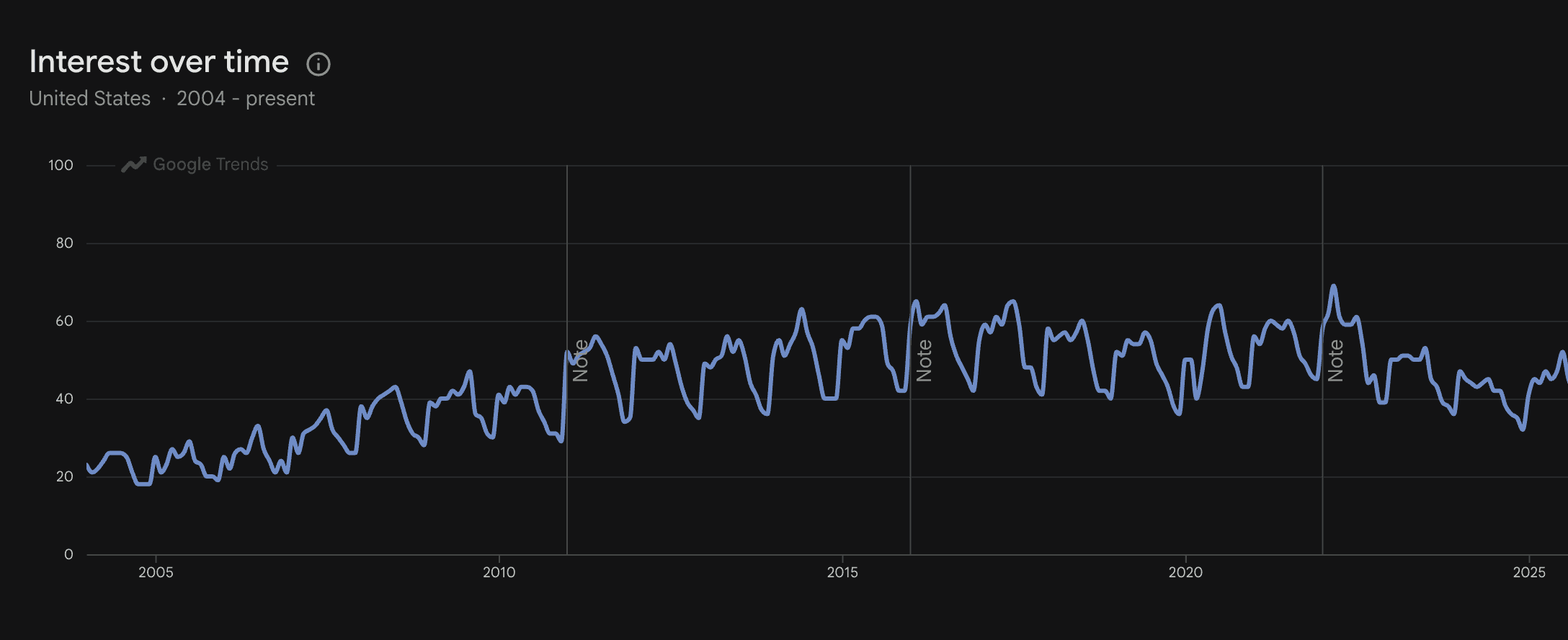
That's not a rent discount, that's a demand drop. A third fewer people are looking. Same house, same price, a third of the traffic.
In that same reddit thread mentioned above, one landlord says the key window is May through August. Another says November and December are the slowest and things pick back up in February. A third describes a September vacancy that didn't fill until the end of November, when he normally leases in about 15 days.
If your lease is ending in October, you've already made your hardest decision and you made it a year ago. That's why we solve lease terms backward from a prime-season expiration instead of defaulting to 12 month leases.
What actually moves the clock
In rough order of impact.
Price bracket, not price.
Renters filter on Zillow in round numbers. A house worth $1,765 gets listed at $1,699, because $1,699 lands inside the under-$1,700 filter and $1,765 does not. The target is the top of the bracket below. That's why our discount is almost never exactly 5%.
Listing the day notice comes in.
Not the day they move out. You want a waitlist built before the house is even empty. We don't show units while a tenant is still living there, but nothing stops you from advertising and booking showings for the day it's vacant.
Photos.
Twelve to fifteen is the floor. Around twenty to twenty five is the sweet spot. Past thirty you're over-doing it.
Speed of response.
Our median time from a lead coming in to a showing being booked is 1.1 hours. Renters are shopping five houses at once. The one that answers first gets seen first.
Where you list.
About 54% of our leads come from Zillow. We pay the daily boost to stay at the top of results and it runs about $1.50 per listing per day. That's roughly two dollars per tenant lead.
When it's genuinely not the price
There are a few real exceptions.
A house in rough condition, or with a hard layout, or on a busy road, will take longer at any price. If you're renting in a market where rents are flat or falling, last year's number is not this year's number.
But those are reasons to price differently, not reasons to wait.
The rule I'd give you: if you've had a listing up for two weeks and you haven't had a single application, the market has already answered you. Waiting longer doesn't change the answer, it just makes it more expensive.
So what should you expect?
If you're priced into the right bracket, listed with good photos before the unit is empty, and answering leads the same day, two to three weeks is a reasonable expectation in season to get a signed lease. Owners who follow our pricing are usually leased in two weeks or less.
If you're in November, plan on about 50% longer at the same price. Or lowering your price to fill in the same timeframe.
Find out what your vacancy is actually costing you
The frustrating part about vacancy is that it's the only leak on a rental you can't go back and fix. Every other one you can correct at the next renewal. Empty days are gone.
I built a free audit that runs your property one question at a time and puts a dollar figure on each leak, including what your last vacancy cost you. Five minutes, and you get the report whether or not we ever speak.