
Selling a Rental Property With Tenants: What Actually Works
Most owners who decide to sell a rental hit the same wall about a week later. Somebody lives there. They have a lease, they have stuff everywhere, and they didn’t ask for any of this.
I’m a broker and a property manager, so I see this from both sides. The tenant is usually the biggest obstacle in the sale… and sometimes they’re the whole solution.
Can you sell a house with tenants in it? Yes. A sale doesn’t end the lease. The buyer steps in as the new landlord and has to honor the lease and the security deposit. Start with the tenant. They might buy it, want out early, or know a buyer, and that usually beats paying them to leave.

Can you sell a house with tenants in it?
Yes. Nothing stops you from selling a rental while someone lives in it. What changes is what the buyer is getting.
A sale doesn’t cancel a lease. The buyer takes the property subject to it, steps into your shoes as landlord, and collects the rent from the day they close. The tenant accepting the new owner as their landlord even has a name, attornment. In a normal house sale it happens without anybody using the word.
The security deposit follows the house too. In Idaho, where I work, Idaho Code § 6-321 says that when a rental changes owners during a tenancy, the new owner is on the hook to refund the deposit. That’s why deposits typically get credited to the buyer at closing.
How much room you have depends on the kind of lease.
Month-to-month tenants
You can usually end the tenancy with written notice. In Idaho that’s at least one month’s written notice (see Idaho Code § 55-208). Some states and cities require a reason to end any tenancy, even month-to-month, so check before you send anything.
Fixed-term leases
The tenant gets to stay until the lease ends, unless they agree to leave early or the lease has an early termination clause you can actually use. Read the whole lease before you plan anything.
While you’re in there, look for a right of first refusal or an option to buy. If one’s in there, the tenant may get first crack at the house no matter what you want. A few places go further on their own. Washington, D.C., for example, has a tenant opportunity-to-purchase law that can require an owner to offer the property to the tenant before selling (D.C. Code § 42-3404.02).
This is NOT legal advice. Check your state and your city before you send a tenant anything.
Your four options for selling a rental with tenants
With a tenant in place, you’ve really got four ways to do this.
Option | When it works | The catch |
|---|---|---|
Find a win-win with the tenant | They want to buy, want a lease-purchase, want out early, or know a buyer | Only works if you ask early, before you list |
Sell to an investor with the lease in place | Rent is close to market and the tenant pays on time | Investors price it on the rent, not on what a homebuyer would pay |
Wait for the lease to end, then sell vacant | The lease ends in the next few months | You carry the property and its risks the whole time |
Pay a lease buyout, then sell vacant | Nothing else worked and the lease has months left | You’re at the tenant’s mercy, and it usually comes out of your side |
Start at the top. The win-win costs you the least. The buyout is the last thing you reach for, not the first.
Step 1: Find the win-win before you pay anyone to leave
Can you get it sold at the price you want without paying cash for keys? Most of the time, yes. Ask early, line up the options below, and the buyout becomes the fallback, not the plan.
It starts with the person living there. Ask the tenant first. Every time. They’re the most likely buyer you’ve got. They already live there, and they already like it enough to stay.
At Bellhaven, we ask every tenant at move-in whether they’d be interested in buying someday. That one question turns a rent roll into a buyer list.
Then, before you list, sit down with your tenant and ask what would work for them. Any of these four answers can get you sold without writing anybody a check.
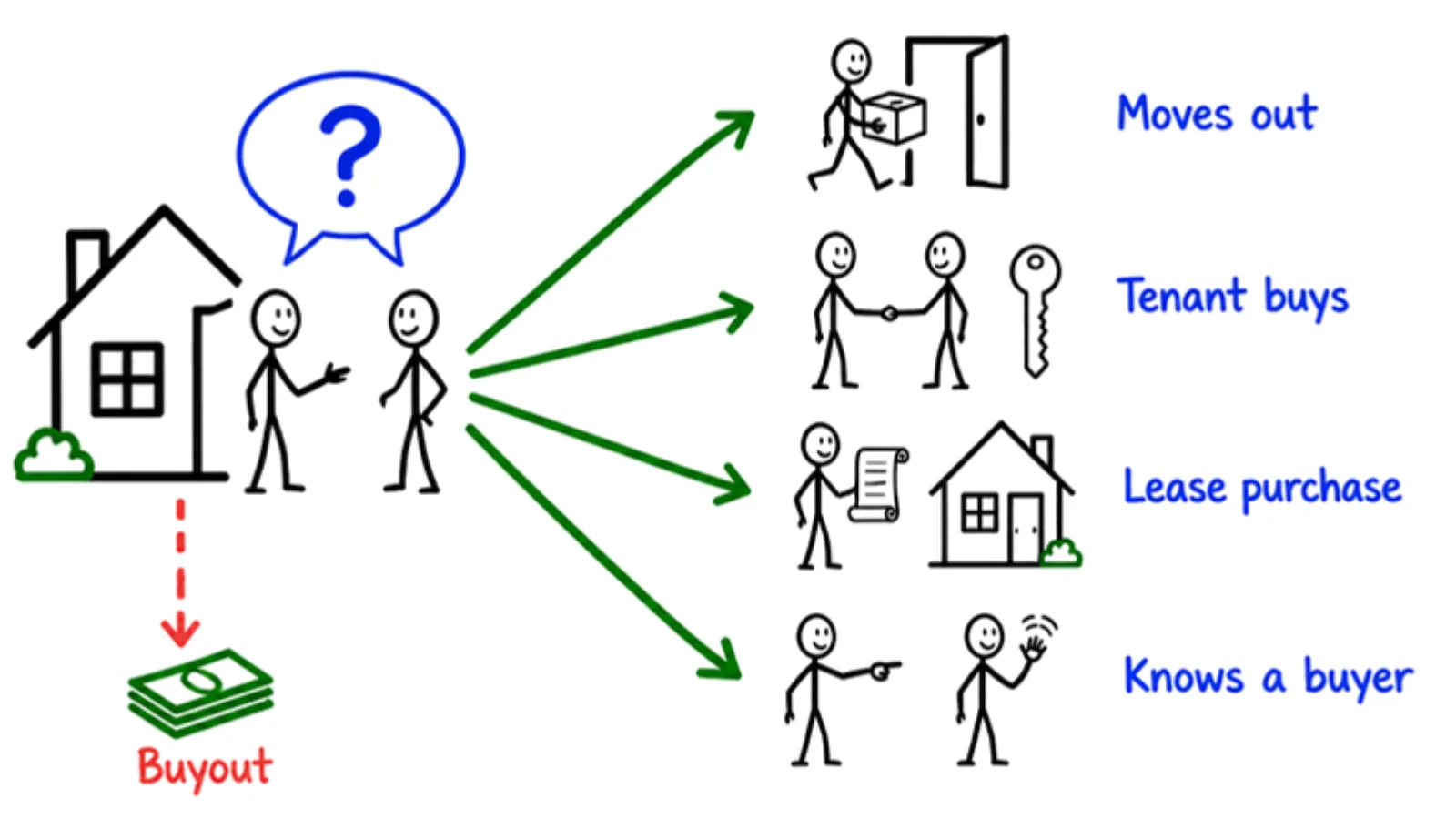
They want out early anyway. Let them out.
Plenty of tenants are already thinking about a new job, a bigger place, or a house of their own. If yours wants out, let them out. You get a vacant, showable house for free.
I had an owner whose tenant had already been asking to leave early. The biggest obstacle to the sale turned into the solution, for free.
Put it in writing as a mutual early termination: the move-out date, the condition you expect, and how the security deposit gets handled under the lease and your state’s deposit law. If the lease has an early termination fee, you get to decide whether to charge it. Even waiving the whole thing costs you a lot less than a buyout.
They want to buy it.
This is often the cleanest sale there is. No showings, no make-ready, no vacancy, no strangers walking through anybody’s bedroom. They know the house better than any inspector will.
The catch is financing. Have them get pre-approved early so you both find out fast whether it’s real.
They’d rather do a lease-purchase.
Some tenants want to buy but can’t qualify yet. It fits a specific person: somebody with money saved who doesn’t have the credit yet. A lease-purchase (rent-to-own) can bridge that. They keep renting, usually at a higher rent, part of it may be credited toward the price, and they buy at a set price by a set date.
Be honest about the trade-offs. You don’t get paid off until they actually close. If they never qualify, you’re back to square one, a year or two later. And these deals are tightly regulated in some states, so getting one wrong can get expensive.
This one is attorney first. Have a local real estate attorney draft it, and put every dollar in writing: the option fee, any rent credits, who handles repairs, and what happens to that money if they don’t buy.
They know somebody who wants it.
Ask. Tenants have brothers, coworkers, and friends who’ve been in the house and liked it. One of them might be your buyer.
Make it easy for them to help without bringing money into it. Offer a flexible move-out date, showings that work around their schedule, and a fast deposit refund when they go.
If none of those land, then you look at paying them to leave. Not before.
If you have a property manager, ask them: “Do you ask tenants at move-in whether they’d want to buy? Has mine ever said yes?”
Step 2: If nothing else works, price the lease buyout honestly
If the tenant isn’t buying, doesn’t want out, and the lease has months left, you can offer them money to leave early. People call it cash for keys.
Just know you’re at their mercy. They can say no, or they can name their price. A normal number is $5,000 to $10,000. I don’t think many buyers will pay that for a couple of months of time, so it usually comes out of your side.
Put the deal in writing: the move-out date, the condition you expect, how the deposit gets handled, and when the money changes hands. Pay when they hand over the keys, not before.
Worked example: win-win vs. buyout vs. selling occupied
Say a house would sell for $300,000 empty to a homebuyer. An investor offers $285,000 with the tenant and lease in place. Rent is $1,800 a month. Plan on 9% in selling costs either way, and two empty months whenever you sell vacant.
Sell occupied to an investor | Tenant leaves early, no buyout | $7,500 buyout | $10,000 buyout | |
|---|---|---|---|---|
Sale price | $285,000 | $300,000 | $300,000 | $300,000 |
Selling costs at 9% | -$25,650 | -$27,000 | -$27,000 | -$27,000 |
Lease buyout | $0 | $0 | -$7,500 | -$10,000 |
Rent lost while it sits empty | $0 | -$3,600 (2 months) | -$3,600 (2 months) | -$5,400 (3 months) |
Left before the mortgage payoff | $259,350 | $269,400 | $261,900 | $257,600 |
The win-win nets $269,400. That’s $10,050 more than selling occupied, and the full $7,500 more than paying the same tenant to leave. At $7,500 the buyout still beats the investor sale by $2,550. Bump it to $10,000 and add one more empty month, and you’d have been better off selling with the tenant in place. Run that comparison before you offer anybody money. Your numbers will be different. The math works the same way.
Step 3: Don’t burn days on market while you can’t show it
This is the move most landlords never think of.
If you put a tenant-occupied rental on the open market early, you can’t do many showings. It sits. By the time you CAN get people in, the listing looks stale, and buyers assume something’s wrong with it. Days on market is a reputation. Spending it while you can’t show the house is spending it for nothing.

Do this instead.
Have your agent let the other agents in your area know one is coming.
Send a reminder every couple of weeks so it stays top of mind.
Go live on the open market about 30 days before the lease ends.
One heads-up. Most MLSs have rules on how a home can be marketed before it’s listed, and an email to other agents can count. Under NAR’s Multiple Listing Options for Sellers policy, a seller can sign a disclosure and have the listing filed with the MLS while it stays off the big public home sites for a delay period the local MLS sets. That’s the clean way to run a quiet pocket listing like this. Your agent should know your MLS’s version.
Showing a house with a tenant in it
Showings are where these sales go sideways. Tenants are sensitive about strangers walking through their home, and honestly, they should be.
Give notice before every showing, keep them to set windows, and only book buyers who are pre-approved or can show proof of funds. Your tenant shouldn’t have to clean up for somebody who was never going to buy. In Idaho, the Attorney General’s landlord-tenant manual says the lease should spell out your right to enter to show the property at convenient times. If yours doesn’t, ask the tenant and agree on a time.
Selling occupied to an investor
Homebuyers want to move in. It’s notoriously hard to sell an occupied rental to somebody who wants to live there. Investors get it. To them, a good tenant on a fair lease is a feature.
They’ll underwrite the rent you actually collect, not the story in the listing. Have this ready before you list:
A rent roll with each unit’s rent, deposit, and lease end date
Copies of every lease and addendum
The tenant’s payment history
A signed estoppel certificate where the tenant confirms the rent, the deposit, and that nobody owes anybody
If the rent is well under market, an investor prices that in. A $300-a-month gap is $3,600 a year they’ll subtract from what they’re willing to pay.
Plan on 9% in selling costs, and check the tax clock
Most people plan on 6%. Plan on 9%. That covers commission, title, closing costs, and a buyer asking for help with their costs. On a $300,000 sale that’s $27,000 instead of $18,000. I’d rather you be pleasantly surprised.
Then call your CPA before you list, not after. Two questions to bring.
Did you live in it two of the last five years?
If you owned it and lived in it as your main home for at least two of the five years before the sale, IRS Publication 523 says you may be able to exclude up to $250,000 of the gain, or $500,000 if you’re married filing jointly. Depreciation you took while it was a rental doesn’t get excluded. And that window closes on its own. Every month you wait, you’re closer to losing it.
Are you trading into another rental?
A 1031 exchange can defer the tax if you roll the money into another investment property. The deadlines are strict: 45 days to identify the replacement and 180 days to close, under 26 U.S.C. § 1031. Set it up before you list, because the clock starts when you sell.
Not sure you should sell at all? Run it through our rent vs. sell calculator, or read where the money actually goes when a rental loses money. This is NOT tax advice. Get your own CPA.
FAQ: selling a house with tenants in it
Is it harder to sell a house with tenants?
Usually, yes. You get fewer showings, homebuyers can’t move in right away, and the buyer pool shrinks to people who can wait or who want the rent. That’s why asking the tenant first and timing the listing matter so much.
How much notice do I have to give tenants if I want to sell?
In most places, deciding to sell doesn’t trigger a notice by itself. A few places with tenant purchase-rights laws, like D.C., can require one. You still owe notice before showings, and if you want the tenant out, whatever notice your lease and state require. In Idaho, ending a month-to-month tenancy takes at least one month’s written notice. A fixed-term lease generally runs to its end.
Can I sell my rental without paying the tenant to leave?
Usually, yes. Ask the tenant first. A lot of the time they want to buy, want out early anyway, would do a lease-purchase, or know someone who wants the house. Line those up before you list, and keep cash for keys as the fallback.
Is winter a bad time to sell a rental?
Not as bad as people think. Rental demand swings a lot between summer and winter. Home sales swing a lot less. Here’s what I tell clients: about 55% of homes sell in the summer months and 45% in the off months. You might take a 2% or 3% lower price and wait longer. Just try to go live before Thanksgiving.
Selling a rental in Idaho?
We’re a brokerage that also manages rentals, so a tenant in the house is normal for us. We’ll start with your tenant, look for the win-win, pull real comps, and only run buyout math if we have to.