

How to Convert Your Primary Residence to a Rental Property (2026)
You’re moving, the house is in good shape, and selling it feels like giving something up. Maybe you’ve got a 3% mortgage you’d never get again. So you’re thinking about keeping it and renting it out.
I’m a property manager and broker, and “should I keep my house as a rental?” is one of the most common questions I get. Here’s how the conversion actually works, and how to tell if it’s worth doing.
Short answer: To convert your primary residence to a rental property, confirm you’ve met your mortgage’s occupancy requirement (usually one year), run the numbers with vacancy, reserves, and management included, switch to a landlord insurance policy, and screen your tenant. Then watch the tax clock: the home sale exclusion fades about three years after you move out.

First, why are you keeping it?
Before any math, I ask owners one question: why do you even want it? The answer changes which numbers matter.
Good reasons look like this. You’re moving back in a few years. It’s truly for your kids. You’re buying it as a long-term retirement asset in a market that’s appreciating. Or you’ve got a mortgage rate so low it’s basically free money, and the rent covers the costs.
That last one is the best argument for keeping a house I know. A low rate is something you can’t buy back once you sell.
Weak reasons sound like “I don’t want to sell right now” or “I hear rentals are good for taxes.” Tax write-offs on a single-family rental rarely pencil out the way people think. If you can’t name the reason, the rest of this article is going to tell you to sell.
Step 1: Check your mortgage’s occupancy clause
When you bought the home as your primary residence, you promised the lender you’d live there. Most conventional loans use the standard Fannie Mae and Freddie Mac deed of trust, which says you must move in within 60 days of closing and live there as your principal residence for at least one year, unless the lender agrees otherwise or circumstances beyond your control come up.
FHA loans have the same rule. HUD Handbook 4000.1 requires at least one borrower to occupy the property within 60 days and intend to keep living there for at least one year.
Once you’ve honestly lived there that first year, you can generally rent it out without refinancing. You don’t need a new loan just because the house became a rental. What you can’t do is buy a house “as a primary residence” when you always planned to rent it. That’s occupancy fraud, and it’s the one shortcut here I’d never take. Here’s more on what lenders mean by an owner-occupied property.
One more thing: if you’re thinking about moving the house into an LLC, talk to an attorney and your lender first. Transferring title can bump into the due-on-sale clause in your loan.
Step 2: Run the numbers like an investor, not a homeowner
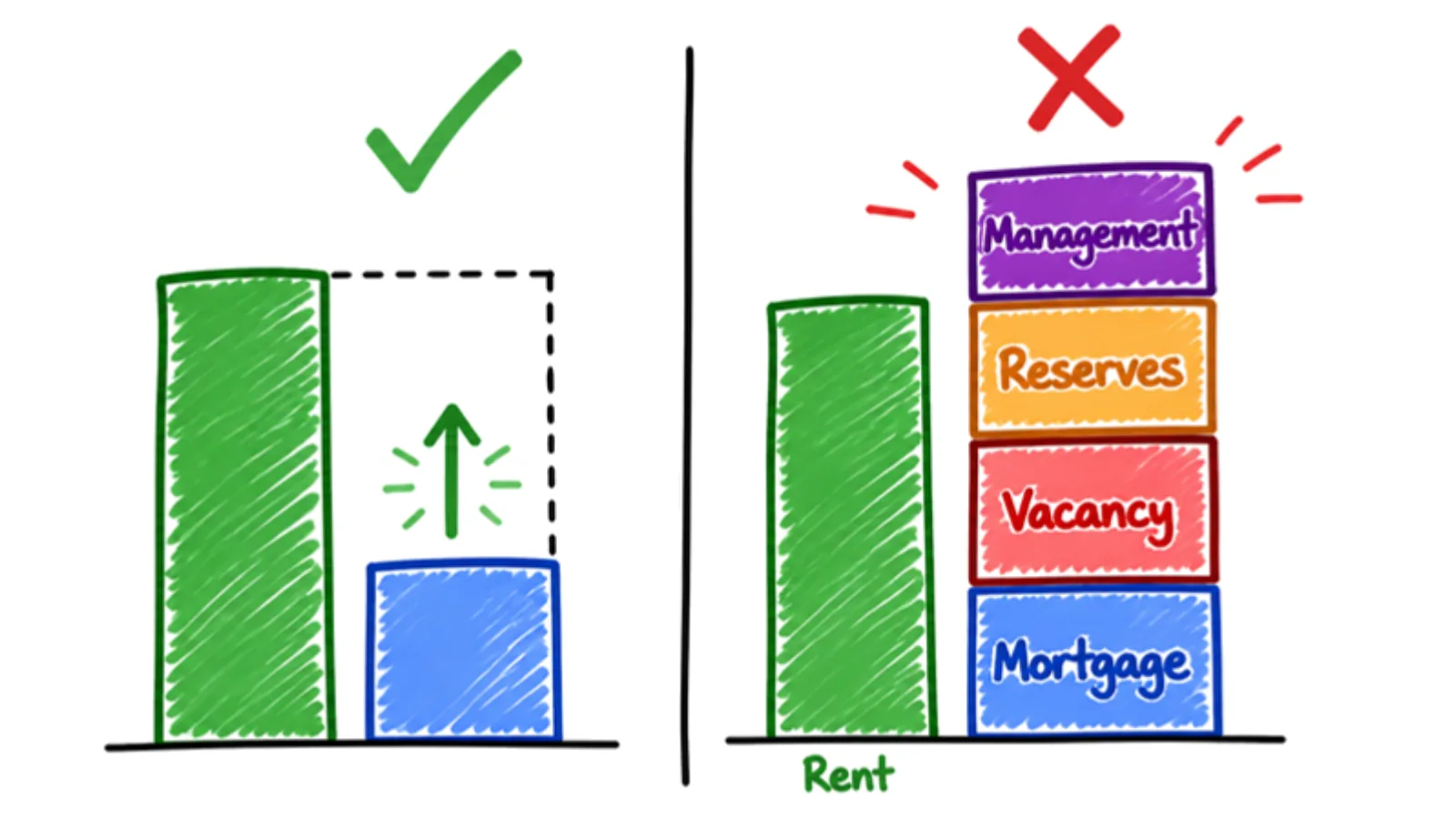
Most owners do the math like this: rent minus mortgage equals profit. That number lies to you.
A rental has costs you never paid while you lived there. The house sits empty between tenants. Things wear out faster. Someone has to answer the phone at 9pm when the water heater goes. And the big replacements, like a roof, furnace, or water heater, come every 5 to 10 years. The ones that really get you are the ones you didn’t plan for.
So I count three things most people skip:
Vacancy
Two weeks empty is about 4% of your rent for the year (14 ÷ 365). At $1,800 rent, every empty day costs you about $59. If you’re curious how long it should take, here’s how long it takes to rent out a house.
Reserves
Set aside 1% of the home’s value every year on a newer house, and 2% on an older one. You won’t spend that every year. It’s for the year the roof or furnace goes. Keep it in a separate account so it doesn’t quietly turn into vacation money.
Management
Budget a manager’s fee even if you plan to do it yourself. It costs you either money or time, and your time isn’t free.
A worked example: the “$530 a month” house
Here’s a typical setup. The house is worth $400,000. You owe $260,000 on a 3% loan you took out a few years ago, so principal and interest run $1,250 a month. Property taxes are $200 a month and a landlord policy is $120. It rents for $2,100.
Rent minus the mortgage payment says you’re making $530 a month. Now add the real costs:
| Monthly line | Amount |
|---|---|
| Rent | $2,100 |
| Principal and interest (3%) | −$1,250 |
| Property taxes | −$200 |
| Landlord insurance | −$120 |
| Vacancy (about 4%) | −$84 |
| Reserves (1% of value a year) | −$333 |
| Everyday repairs | −$100 |
| Management (budgeted at 10%) | −$210 |
| Cash flow | −$197 |
That “$530 a month” house loses about $197 a month, or roughly $2,400 a year, once everything’s counted.
Is that a reason to sell? Not by itself. Your tenant is also paying down about $600 a month of principal right now. And look at the rate. Someone borrowing that same $260,000 at Freddie Mac’s recent 7.24% average would pay about $1,772 a month in principal and interest, $522 more than you. That’s what your 3% is worth.
Then do one more test. If you sold, you’d walk away with about $104,000 after a 9% cost of selling (plan on 9%, not 6%). Divide your yearly cash flow by that number. If a boring money market or index fund beats it with zero tenants and zero phone calls, your equity probably belongs somewhere else. Any investment that breaks even is a lot better than one that loses money every month.
Our rent vs. sell calculator runs both paths side by side, including the tax pieces below.
Step 3: Know the tax clock before you sign a lease
This is the part people find out about too late. I’m a broker and property manager, not a CPA, so treat this as the map and get your own CPA for the route.
The 2-of-5-year rule
When you sell a home you lived in, you can usually exclude up to $250,000 of gain ($500,000 married filing jointly) if you owned it and used it as your main home for at least 24 months of the 5 years before the sale. That’s the rule in IRS Publication 523 and 26 U.S.C. § 121.
Here’s the good news for converters. The years it’s rented after you move out don’t count against you as “nonqualified use.” So if you lived there two years, you can rent it for up to about three years and still sell inside the window.

The bad news: that window closes on its own. Every month you rent it is a month closer to losing the exclusion. If you’ve got a big gain, that’s why I tell owners the longest I’d rent it before selling is two or three years. Here’s more on capital gains on real estate.
Depreciation, and why it comes back
Once it’s a rental, you report the rent and expenses on Schedule E, and you depreciate the building over 27.5 years. Per IRS Publication 527, your starting basis is the lesser of the home’s fair market value or your adjusted basis on the day it became a rental. Land doesn’t count.
Say your adjusted basis is $310,000 and the land is worth $70,000. You’d depreciate about $240,000, or about $8,700 a year. Three years of that is about $26,000.
Even inside the 2-of-5 window, you can’t exclude the depreciation you took (or could have taken). It gets taxed as unrecaptured section 1250 gain at up to 25%, per IRS Topic 409. On $26,000, that’s up to about $6,500. Skipping the deduction doesn’t help, since the IRS counts depreciation “allowed or allowable.” Here’s how depreciation recapture works.
Step 4: Using the rent to buy your next house
A lot of owners want to keep the old house and buy the next one. Whether the old house’s rent helps you qualify depends on your loan program, and the rules just changed.
For conventional loans, Fannie Mae’s Selling Guide (B3-3.8-05) changed this fall: for loan applications dated November 1, 2026 or later, lenders no longer use a lease for a departing residence. The lender documents market rent instead, counts 75% of it, and subtracts the full payment. In the example above, 75% of $2,100 is $1,575, which just covers the $1,570 payment. If you have less than a year of landlord experience, expect to show six months of that payment in reserves.
FHA is stricter. Under HUD Handbook 4000.1, you generally need to be relocating more than 100 miles away, have a lease of at least a year with proof of the deposit or first month’s rent, and have at least 25% equity in the house you’re leaving.
Don’t guess at this. Get pre-approved early, with a loan officer who understands investors, and understand your program options before you pick a house.
Step 5: Switch your insurance
The biggest mistake I see is keeping the homeowner’s policy after the house becomes a rental. You’re paying to cover furniture you took with you, and many homeowner’s policies limit or exclude coverage once the home is rented. Call your agent and move to a landlord (dwelling) policy before the tenant gets keys. Add loss-of-rent coverage, and require your tenant to carry renters insurance with liability.
Step 6: Decide who’s going to run it
This is a business now. Comfort kills profits.
The tenant you pick matters more than anything else on this list. Write your screening criteria down, verify income and rental history, and apply the same rules to everyone. That includes the coworker or friend-of-a-friend who wants your place. Skipping screening for people you know is how a lot of first rentals go sideways.
Don’t do the repairs yourself unless it’s your licensed trade. And be honest about distance. If you’re moving across the state or across the country, “a neighbor will keep an eye on it” isn’t a plan. Someone needs to inspect it, handle calls, and catch the slow leak before it turns into a $1,420 bill.
If you hire a manager, interview two or three. Here are the questions to ask a property management company before you sign. A good one will also tell you when it’s time to sell.
Frequently asked questions
How long do you have to live in a house before renting it out?
Most primary-residence loans, conventional and FHA, require you to move in within 60 days and live there at least one year. After that, renting it out is generally fine. For the tax exclusion, you need 2 years of living there within the 5 years before you sell.
Can I rent out my house if I still have a mortgage?
Usually yes, once you’ve met the occupancy requirement. You don’t need to refinance. Read your loan documents, switch to a landlord policy, and check with an attorney before moving title into an LLC.
Can I rent out my house and buy another?
Yes, and it’s one of the easiest ways to start owning rentals. Just know the old payment counts against you unless your loan program lets you offset it with rent, and that you may need extra reserves. Get pre-approved before you house hunt.
What happens to taxes when my home becomes a rental?
Rent becomes taxable income on Schedule E, and you can deduct expenses and depreciation. When you sell, depreciation is taxed even if the rest of the gain is excluded.
Should I sell or rent out my house?
Keep it if you have a clear reason, a low rate, and real cash flow after vacancy, reserves, and management. Sell if it loses money every month and you can’t say why you’re holding it, ideally while you’re still inside the 2-of-5-year window.
Keeping it? Run it like a business from day one
If your house is in Idaho, Bellhaven can take it from move-out to a screened tenant and handle it from there, so the house keeps working while you’re living somewhere else. See our property management.
Anywhere else, run our free rental audit. It takes about five minutes and shows where a rental is leaking money before it costs you a year of cash flow.
This is general information, not tax, legal, or lending advice. Talk to your CPA, attorney, and loan officer before you convert a home to a rental.